

On 24 February 2019, Baker Street switched to two-way traffic following the removal of the gyratory system in Gloucester Place and Baker Street. The improvements across this wide area were noticeable within just a few days of the changeover.
As key advocates for this project, we worked closely with delivery partners Westminster City Council and Transport for London, with support from Baker Street Quarter Partnership.
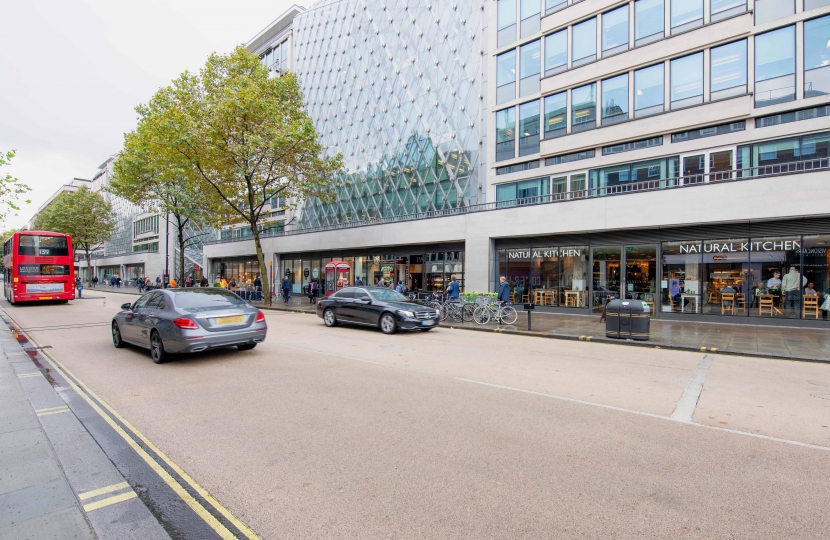

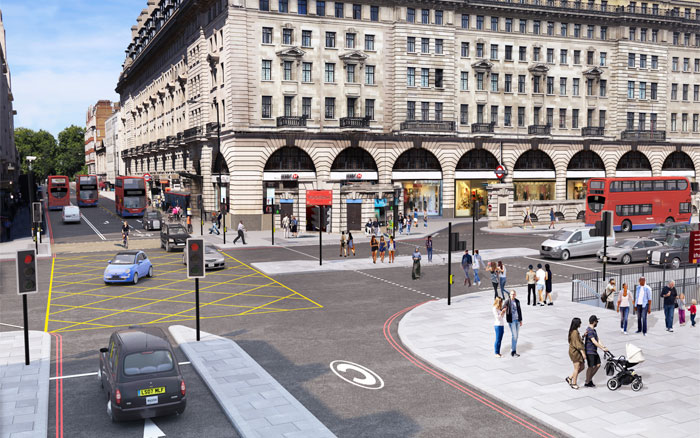
For decades, Baker Street and Gloucester Place operated as a one-way system, creating a road that prioritised vehicles over pedestrians and cyclists. The new two-way system has reversed this hierarchy and allowed for the following benefits:
- Improved safety for pedestrians and cyclists
- Reduced traffic speeds and congestion
- Enhanced public spaces with wider pavements
- Better air quality due to decreased vehicle emissions
- Easier navigation for drivers and reduced journey times
The project also introduced new pedestrian crossings, made safety improvements at every junction, provided advanced cycle lanes, and updated traffic signals to ensure smooth traffic flow. Local businesses have benefitted from increased foot traffic, lower noise and a more pleasant street environment.
Outcomes
The monitoring strategy was implemented in 2017 before works commenced and then again in 2019 on completion of the project. The report provides a comprehensive summary of some of the impacts delivered in the first-year post completion.
Key statistics from the monitoring report include:
- Vehicle speeds falling by approximately 25 – 30%, benefitting the safety of pedestrians and cyclists.
- An increase in cycling flows of 15% to 20% on both Gloucester Place and Baker Street where new safety features were introduced.
- An increase of pavement space to create a better high street environment.
- An increase in pedestrian activity of up to 84%, with most activity taking place where new or improved pedestrian facilities were introduced.
- Significant reductions of 35-50% in annual mean nitrogen dioxide concentrations across all sites. (Some of this will have been due to the introduction of ULEZ, however when compared to comparable sites elsewhere the reduction observed was greater.)
- No major delays to vehicle traffic on the network due to the project, with journey times improving in many instances.
The Estate is proud to have been a key part of this project team. The post-implementation report can be viewed here.
